Our history
History of the foundation
Competency-based education (CBE) has grown globally in health professions training, largely driven by the use of Entrustable Professional Activities (EPAs) to gradually build trainee autonomy. To help implement these concepts, the popular, non-profit “Ins and Outs of EPAs” course has expanded worldwide since 2018. Building on this success, the Entrust Foundation was created in 2026 to support global educators—especially in under-resourced countries—through training, degree support, and collaboration.
CBE
Competency-based education (CBE) is a worldwide movement to improve health professions education by ensuring that graduates of both undergraduate and postgraduate training programmes are prepared to meet the standards required for professional practice. Around the turn of the millennium, CBE was introduced for medical education in a limited number of western countries. As the movement grew and expanded to include other health professions, competency-based education was defined in critical components of curricula. Anno 2026 the movement has become significant in several countries in the Global North as well as in the Global South. As evidenced by a continuous stream of publications, competency-based education in the health professions is a continuously evolving field, at the level of individual learners and educators, educational institutions, healthcare organisations, and policy makers.
EPAs
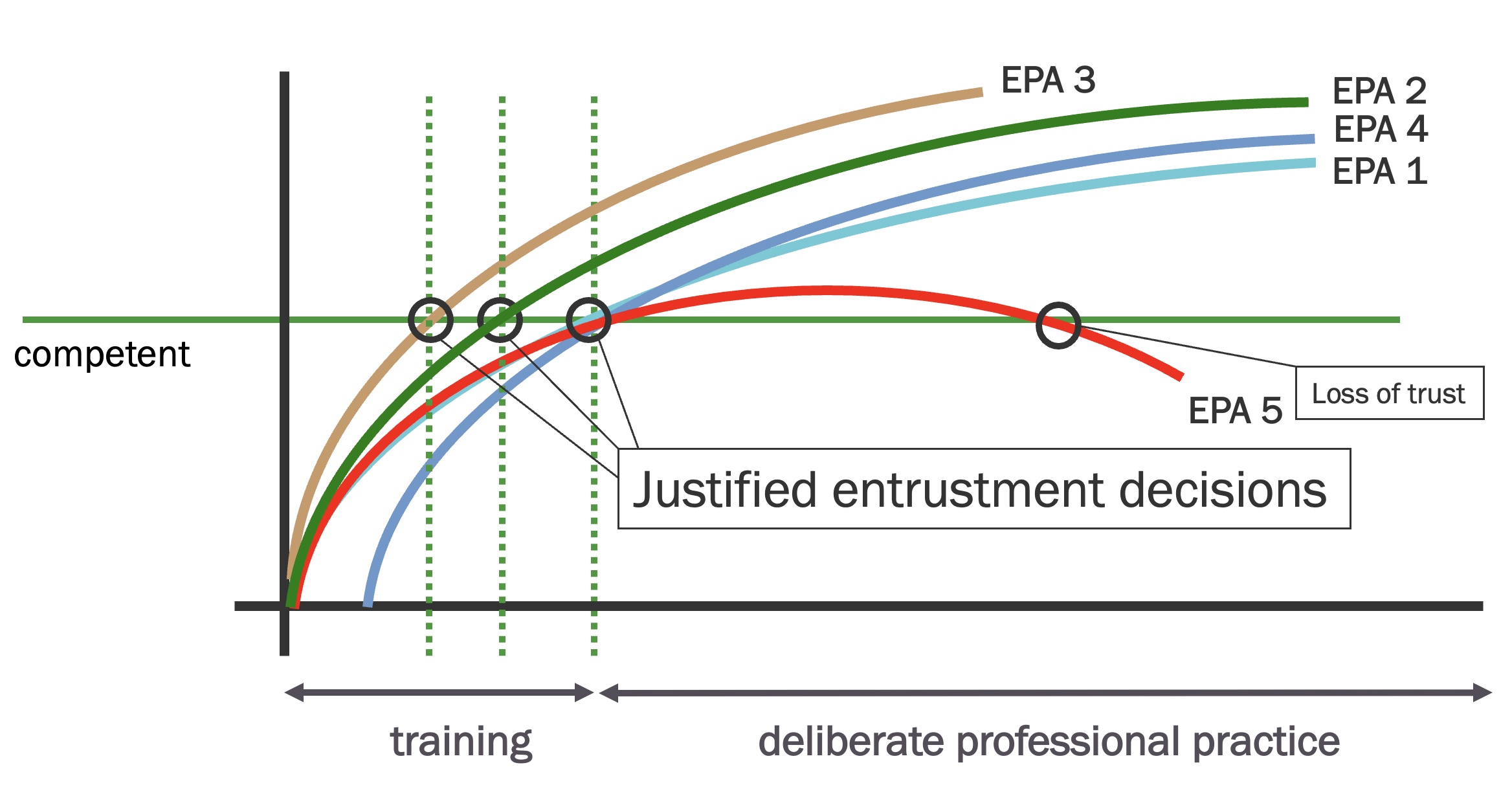
One increasingly popular component of CBE is the application of a new concept: Entrustable Professional Activities or EPAs, in conjunction with entrustment decision making. Launched in 2005, it is now often considered central to competency-based education in the health professions. EPAs are units of professional practice that can be entrusted to trainees to perform safely in patient care, as soon as they demonstrate to have the competencies needed for this entrustment. Rather than qualifying graduates at once with a full license to practices, EPAs build the trainee’s autonomy more gradually during training. EPAs have been welcomed as a useful link between education and clinical practice, but turning the concept into curricula and into procedures to assess trainees is not easy.
COURSES
Since 2018, the international “Ins and Outs of Entrustable Professional Activities” course has been offered as an intensive, multi-day faculty development programme. The course was initially delivered in person in Utrecht (the Netherlands), Singapore and Kingston (Ontario, Canada). Since the COVID-19 pandemic, it has been offered exclusively online, three to four times per year by an international faculty. To date (2026), the course has been attended by more than 700 educators from over 40 countries across all continents, with a steadily growing proportion of participants from low- and middle-income countries. In recent years, interest has expanded to regions where English is not the primary language. As a result, satellite courses have been developed in Spanish, Mandarin, German and Portuguese, as well as tailored editions for the Singapore community and for dental educators. Additional versions for other educational communities are currently in development. All courses, including both the international course and its satellite editions, are offered on a non-profit basis, with substantially reduced course fees for participants from LMIC countries.
FOUNDATION
The idea of establishing the HPE Entrust Foundation in 2026 arose from the ambition to further expand the reach and quality of the Ins and Outs of Entrustable Professional Activities course. At the same time, the Foundation seeks to support educators from low- and middle-income countries in developing expertise in competency-based health professions education, both through and beyond this course. Its activities include supporting access to postgraduate education in Health Professions Education, promoting educational scholarship and publication, and fostering international networks and collaborations.
Entrust symbolizes not only the transfer of clinical responsibilities to the next generation of healthcare professionals, but also the trust and connections that unite students, educators, researchers and institutions worldwide. In a world increasingly characterised by competition, corporatisation, geopolitical tensions and isolationism, the Foundation believes that collaboration, mutual learning and trust are essential for advancing health professions education and, ultimately, healthcare